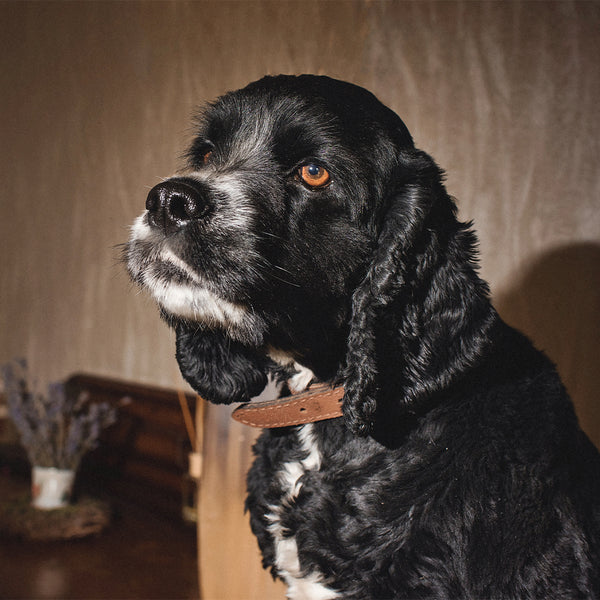

Leonbergers are large, lion-maned working dogs bred in Germany from Saint Bernard, Newfoundland, and Great Pyrenees stock. They are affectionate, trainable, and unfortunately subject to a compressed 8–9 year median lifespan driven by a cluster of serious conditions — most notably a hereditary polyneuropathy unique to this breed, giant-breed joint disease, dilated cardiomyopathy, and osteosarcoma rates consistent with large and giant breeds. The short lifespan makes starting supplementation early — not waiting for symptoms — the correct approach for this breed.
Leonberger polyneuropathy (LPN1 and LPN2)
Leonberger polyneuropathy is a hereditary progressive peripheral neuropathy caused by mutations in two separate genes, designated LPN1 (ARHGEF10 gene) and LPN2 (ITPR3 gene). Both are autosomal recessive. LPN1 tends to cause earlier onset and more severe progression; LPN2 typically presents later and progresses more slowly, though both ultimately cause significant disability.
The pathology involves degeneration of peripheral motor and sensory axons, with secondary demyelination. Clinically, affected Leonbergers develop progressive gait abnormality — a dragging, scuffling hindlimb gait, exercise intolerance, and hindlimb weakness that advances to paresis. In advanced cases, laryngeal paralysis develops, causing inspiratory stridor, voice change, and aspiration risk. Respiratory muscle involvement in very severe cases can compromise ventilation. There is no treatment that reverses LPN — management is supportive, focused on maintaining quality of life and mobility as long as possible.
DNA tests for both LPN1 and LPN2 are available. Responsible Leonberger breeders test all breeding dogs; both parents must be clear or carrier-only (not affected-to-carrier pairs for LPN1) to minimize affected offspring. From a supplement standpoint: omega-3 EPA+DHA supports neuronal membrane integrity and has demonstrated neuroprotective effects in peripheral nerve disease models. While no supplement prevents or reverses LPN, omega-3 at therapeutic doses is rational and broadly supported for a dog with known peripheral nerve disease risk. CoQ10 supports mitochondrial function in neural tissue — relevant given axonal energy metabolism impairment in polyneuropathies.
Hip and elbow dysplasia
Leonbergers are a giant breed — males commonly reach 110–170 lbs. Giant breed joint loading creates significant dysplasia risk regardless of genetic predisposition, and OFA data for Leonbergers shows meaningful hip and elbow dysplasia rates. Joint supplement initiation at 12 months — before symptoms, given that cartilage degradation begins before radiographic or clinical changes are apparent — is standard practice for this breed. Giant breeds require higher absolute doses of glucosamine and chondroitin than the label doses on products calibrated for medium dogs.
Glucosamine (1,500–2,000 mg/day for a 130 lb dog), chondroitin (800–1,200 mg/day), and MSM for anti-inflammatory sulfur substrate are all appropriate. Omega-3 provides additional anti-inflammatory support in the joint synovium. Weight management is critical — every extra pound of body weight adds approximately 3–4 pounds of force on hip joints during movement.
Dilated cardiomyopathy (DCM)
DCM is documented in Leonbergers with meaningful prevalence — the giant breed predisposition to DCM involves myocardial dysfunction with ventricular dilation and reduced contractility, leading to congestive heart failure if untreated. Taurine and carnitine deficiency have been implicated in DCM in several large breeds; their role in Leonberger DCM is not fully established but supplementation at cardiac-support doses is reasonable given the breed risk. Omega-3 EPA+DHA at therapeutic doses (40+ mg per pound bodyweight) has documented benefit in canine cardiac disease, improving cardiac cachexia and reducing inflammatory burden.
Annual cardiac auscultation from age 2 and echocardiography from age 3–4 is the standard screening recommendation for this breed.
Osteosarcoma and GDV
Osteosarcoma risk in Leonbergers follows the giant breed pattern — large bone mass and rapid growth create elevated risk. The appendicular skeleton (distal radius, proximal humerus) is the most common site. No supplement prevents osteosarcoma, but anti-inflammatory and antioxidant supplementation as part of general cancer-risk management is reasonable. Omega-3 is a standard component of veterinary oncology nutritional protocols.
Gastric dilatation-volvulus (GDV) risk is significant in large deep-chested breeds. Preventive gastropexy at the time of spay/neuter is increasingly standard recommendation for Leonbergers. Digestive enzyme support and probiotics support gut motility and microbiome health; feeding from a raised bowl (evidence for this practice in GDV prevention is mixed, but portion management and avoiding exercise immediately post-meal are supported).
The Leonberger supplement protocol
- Joint Care (glucosamine + chondroitin + MSM) — start at 12 months; giant-breed doses. Non-negotiable given size and lifespan compression
- Omega-3 EPA+DHA at therapeutic dose — 40+ mg EPA+DHA per pound of bodyweight; serves joint, cardiac, neurological membrane, and cancer-risk functions simultaneously
- CoQ10 ubiquinol — 200–400 mg/day for cardiac and neurological mitochondrial support
- Taurine — 500–1,000 mg twice daily for cardiac support given DCM risk; discuss with veterinary cardiologist if DCM is confirmed
- Probiotics — gut health and motility support; relevant for GDV risk management
- Start all supplements at 12 months — the 8–9 year lifespan means delaying until age 4 or 5 consumes a disproportionate fraction of the dog's healthy years
LPN1 and LPN2 DNA testing is available through breed registries and commercial veterinary labs. All Leonbergers from breeding programs should have documented LPN status. Annual cardiac screening from age 2–3 is appropriate.
Related: heart health supplement guide · joint supplement comparison · omega-3 for dogs · L-carnitine guide · senior dog supplement guide.