

Apoquel (oclacitinib) and Cytopoint (lokivetmab) are the current standard of care for canine atopic dermatitis, and they work — both drugs produce rapid, meaningful itch reduction in most atopic dogs. But they do so by broadly suppressing immune signaling (Apoquel inhibits JAK1/JAK3; Cytopoint neutralizes IL-31). Understanding what each drug suppresses — and what natural alternatives actually address — determines when a natural approach is a realistic substitute versus an unrealistic one.
How Apoquel and Cytopoint work
Apoquel inhibits JAK1 and JAK3 enzymes that mediate signaling for multiple cytokines involved in the allergic response. It reduces itch within 4 hours but suppresses immune pathways broadly — including some involved in infection surveillance and tumor immunology. Long-term Apoquel use has been associated with reactivation of latent infections and (at higher rates) development of skin masses. It's not that Apoquel is dangerous — it's that it manages symptoms without addressing the underlying immune dysregulation.
Cytopoint is a monoclonal antibody targeting IL-31 — the primary cytokine driving allergic itch. It's more targeted than Apoquel and produces 4–8 weeks of itch reduction per injection. Its immune suppression is more selective (targeting only IL-31) but it still doesn't address the upstream immune regulation problem generating excess IL-31.
Where natural alternatives are realistic
Natural supplements address the upstream problem — the immune overreaction producing excess cytokines, histamine, and prostaglandins. They take longer (6–10 weeks) and produce less complete, more moderate itch reduction than pharmaceutical suppression. For mild-to-moderate atopic dogs, natural management with quercetin + bromelain + therapeutic omega-3 + probiotics produces enough symptom reduction to avoid pharmaceuticals for many dogs.
For severe atopic dogs — dogs with significant secondary infections, year-round severe symptoms, or quality-of-life-affecting itch — pharmaceuticals are often the appropriate first-line treatment, with natural supplements providing adjunct immune support that may reduce the pharmaceutical dose required over time.
The natural protocol for atopic dogs considering alternatives
- Quercetin + bromelain at therapeutic dose: Mast cell stabilization and cytokine suppression. The closest natural analog to Apoquel's mechanism — both address cytokine-mediated itch, but at different pathway positions. Takes 6–8 weeks for full effect.
- Omega-3 (EPA+DHA) at 40–55mg/lb/day: Shifts the systemic inflammatory baseline; reduces the IL-31 production environment that Cytopoint neutralizes downstream. Takes 8–12 weeks.
- Probiotics (multi-strain, 5B+ CFU): Restores gut-immune calibration that reduces T-helper Th2 overactivation — the upstream driver of cytokine overproduction.
- Environmental controls: Reducing allergen exposure (regular vacuuming, HEPA filtration, frequent paw washing after outdoor exposure) reduces the allergenic load the immune system encounters, lowering the threshold for reactions.
Practical transition approach
For dogs currently on Apoquel who want to explore natural management: don't stop Apoquel abruptly. Begin the natural protocol (quercetin + omega-3 + probiotics) at full dose alongside Apoquel. At 8 weeks, with veterinary guidance, consider gradually reducing Apoquel frequency. If symptoms remain controlled, continue the taper. If symptoms worsen, hold. This approach works for mild-moderate atopic dogs more often than attempting cold-turkey transition.
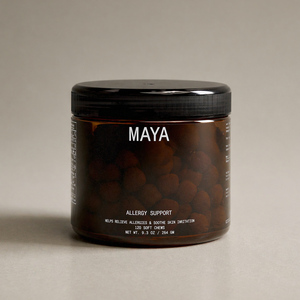
Full allergy protocol: allergy supplement guide · natural allergy remedies · quercetin guide · best allergy supplement guide. MAYA's Allergy supplement combines quercetin, bromelain, omega-3, and colostrum at therapeutic doses.