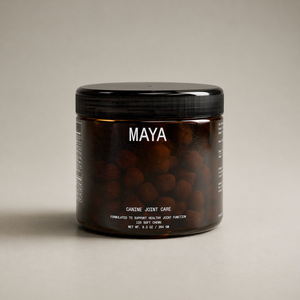


Glucosamine is the most widely used joint supplement in veterinary medicine — given to millions of dogs annually. The evidence supporting it is real, but nuanced: form matters, dose matters, and it works best as part of a complete joint support stack rather than alone. Here's everything you need to know to use glucosamine effectively.
Glucosamine HCl vs. glucosamine sulfate: does form matter?
The two forms differ in the anion attached — hydrochloride (HCl) vs. sulfate. The bioactive compound is the glucosamine cation in both cases. Human studies initially showed sulfate advantages, but subsequent analysis showed the sulfate was also providing additional sulfur — not that the sulfate form was intrinsically superior. In dogs:
- Glucosamine HCl is more concentrated (83% glucosamine vs. ~65% for the salt form) — providing more glucosamine per gram of raw material
- Both forms are adequately bioavailable in dogs
- The clinical outcomes are comparable when dose-matched
Weight-based dosing: what clinical trials use
| Dog weight | Glucosamine dose/day | Chondroitin dose/day | MSM dose/day |
|---|---|---|---|
| Under 25 lbs | 250–500 mg | 200–400 mg | 500 mg |
| 25–50 lbs | 500–1,000 mg | 400–800 mg | 1,000 mg |
| 50–75 lbs | 1,000–1,500 mg | 800–1,200 mg | 1,500 mg |
| 75–100 lbs | 1,500 mg | 1,200 mg | 2,000 mg |
| Over 100 lbs | 2,000 mg | 1,600 mg | 2,500 mg |
Most commercial glucosamine supplements are calibrated for 30–50 lb dogs. Large and giant breeds frequently receive inadequate doses when owners follow label directions without adjusting for body weight.
How glucosamine works — and why it's slow
Glucosamine is a substrate for glycosaminoglycan synthesis — the building blocks of cartilage matrix (aggrecan) and synovial fluid (hyaluronic acid). It takes 4–12 weeks to produce measurable changes in cartilage composition. This is not a sign of ineffectiveness — cartilage is avascular and metabolically slow. Owners who stop at 4–6 weeks often miss the full effect.
MSM provides faster-onset benefit (2–4 weeks) through direct anti-inflammatory effects (NF-κB inhibition) while glucosamine works on longer-term structural remodeling. This is why the combination outperforms either alone.
The complete joint supplement stack
Clinical studies on osteoarthritis in dogs show the most consistent benefit from the four-compound stack:
- Glucosamine HCl — cartilage matrix substrate
- Chondroitin sulfate — blocks cartilage-degrading enzymes (MMP-13, aggrecanase)
- MSM — faster-onset anti-inflammatory (NF-κB, COX-2 inhibition)
- Omega-3 (EPA+DHA) — systemic anti-inflammatory addressing the synovial inflammation component
Turmeric/curcumin with enhanced bioavailability (piperine) is an appropriate fifth addition for dogs with significant osteoarthritis pain, adding COX-2 inhibition through a different pathway than MSM.
Related: glucosamine guide · joint supplement guide · hip dysplasia guide · arthritis guide · MSM guide.